Friday, March 13, 2026

Family Group Friday: the Watsons


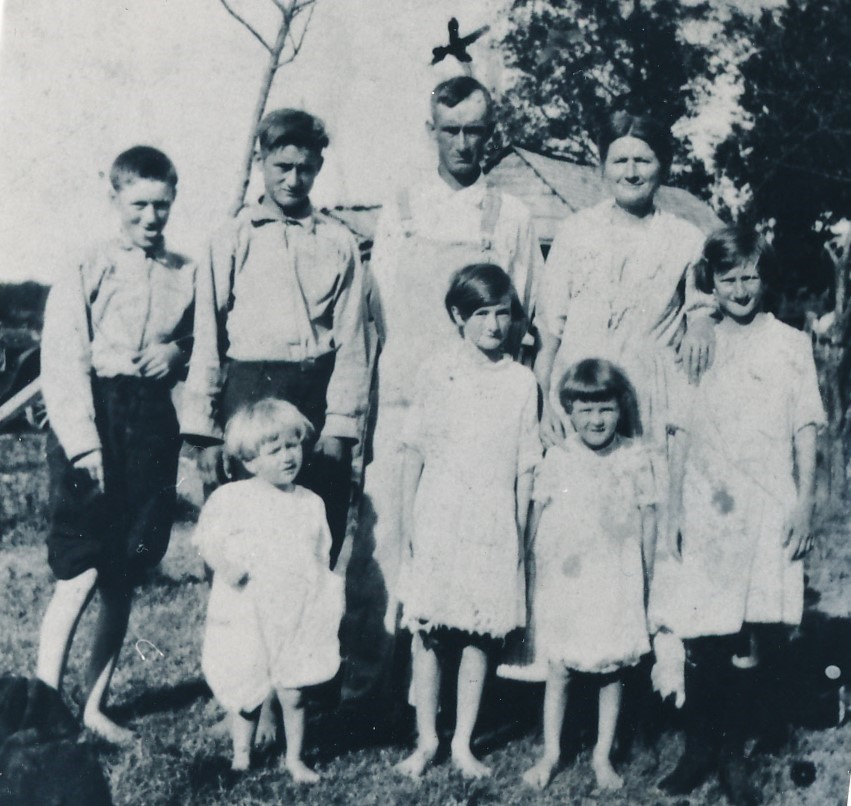
Charles Bryant and Rockie Lenora Brown Watson and their family


Left to right: Lewis Watson, Lloyd Watson, Charles Bryant Watson, Marie Watson, Rockie Brown Watson, Hugh Watson, Ollie Watson Love, Irvin Love, Thelma Watson, Rupert Watson, Aletha Morris Watson. Uncertain at this time the names of the children pictured.

Their children were: 


Back row: Ola Peeples Yarborough, 2nd wife of Jim Yarborough after Thelma died. Thelma was the daughter of Bryant & Rockie; Violet Marie Watson Fortner, married to Lonnie Lee (Pat) Fortner,daughter of Bryant & Rockie; Leatha Morris Watson, wife of Rupert Calvin Watson,son of B&R; Irene Looney Watson, wife of Thomas Hugh Watson, son of B&R. Front row: Lewis Charles and Vera McDonald Watson. Lewis was the son of B&R; Lloyd Bryant & Sudie Yarborough Watson. Lloyd was the son of B & R. Sudie and Jim were brother and sister who married Thelma and Lloyd, brother and sister. Some good, good people, and I miss every one of them. - Mary Sue Watson Boatman


Wednesday, March 4, 2026

The Archive of Aches of Grandma Watson

             I have recently been engaged in assembling the stories and documentation I have collected over the decades I have been researching into a book of sorts that I can print and share easily. Through this process, I have gathered many newspaper items preserved on newspapers.com that mention my ancestors. This has been a fascinating look into their presence in the community. As I was going through the Webster Progress (a newspaper based in Webster County, MS) in the 1960s, I was both delighted and a little regretful to find a series of items detailing the injury and subsequent illness of my great-great grandmother, Rockie Brown Watson. I have written about her previously in Rockie Brown. There are a few items in 1961 and early in 1962 that mention family members visiting Rockie. On March 15, 1962 we learn of her 88th birthday party. 

        Two short months later we learn that she has had a bad fall and broken her hip.

        
         Then there is a series of items telling of her family visiting and describing her state of health.


Then we learn that she has been taken to the hospital but seems to be improving.


A little over a month after she went to the hospital, we learn that Rockie has passed. 


           I think my favorite part of this is the letter from the family that is signed "The family of Mrs. Rockie Watson (Grandma Watson). This shows the love of the community for this special woman and the spread and influence that she and her descendants had on the community in Webster County. And now, over 125 years after she and Charles Bryant started their family, the presence and influence of her family continues.


Friday, July 11, 2025

Family Group Friday - Scruggs


 From Left to Right: Henry E Scruggs, Doc B Scruggs, Violet L. Scruggs Harris, Beulah Scruggs Plunkett, Sarah Ann Ward Scruggs holding Willie Scruggs McCaleb, Sarah Jane Scruggs (standing), Major J Scruggs, Luther Scruggs, and Sarah Jane Scruggs (not pictured John T Scruggs)


Beulah Scruggs was born in the heat of July 6 in 1884 in Lee County, MS. Her father was raised in Tennessee and had come to Lee County with his brother to farm the land. Her mother grew up in nearby Itawamba County and spent her days managing her ever-growing family. By 1900 they owned their home and land outright.   

Beulah married James Washington Plunkett on Christmas Eve in 1906 when she was 22 years old and he was 24. They moved Mooreville in east Lee County to be near his mother and younger siblings. Jim and Beulah went on the have seven children and eventually moved to Troy, in Pontotoc County, MS and then Shannon, in south Lee County. They attended Bogafala Church.  In 1948, at only 55 years old, Beulah suffered a prolonged illness that eventually took her life. 

One of Beulah's daughters was Sula Plunkett, my great grandmother.


Beulah and three of her grandchildren. 

Friday, August 23, 2024

Family Group Friday - Plunketts


Back row left to right: Curtis Plunkett, Chester Plunkett, Jim Plunkett, Beulah Scruggs Plunket
Front row left to right: Henry Plunkett, Ouida Plunkett, Sula Plunkett and Florene Plunkett


Sula Plunkett is my great-grandmother. I remember her well, as well as her sisters Ouida and Florene (or as I called them Aunt Weeder and Aunt FloRene). Henry died in France during WWII. 


Friday, September 29, 2023

Family Group Friday: The Conways


The Conway Family in 1925


Left to right: Jeff, Dude?, Mahuldy, Jefferson, Ruth, Mollie, Sam, Mae, and Lou

Jefferson Conway married Mahuldy Catherine Rice

Children: W. F. Conway (not pictured)
Mollie Savannah (pictured with son, Jeff, and daughter, Ruth)
James Henry (not pictured)
Samuel J (pictured with wife, Lou, and daughter, Mae)
Nancy Catherine (not pictured)
Rebecca (not pictured)
Dora E (not pictured)
Willie (not pictured)


The Conways immigrated from England before 1700. 

Friday, September 15, 2023

Family Group Friday - The Kolbs


Seated: Andrew Egger Kolb and Margaret Murrah Kolb

Children left to right standing; William Serenus, Martha Theodosa, Andrew Elzie, Ezra and Avery Egger
Children left to right front: Clara (my great grandmother), Rutha Mae, and Zada

Andrew Egger Kolb was the son of James Kolb and Rhoda Egger who migrated to Mississippi from South Carolina with James's family.  He was married to Martha McCarter and Margaret Murrah. 

Served in the Civil War from 1862 - 1865. He left behind a journal he kept during the war. 


Sunday, September 3, 2023

William Biles: An American Quaker Pioneer

Early Life and Education
Born in Dorchester, Dorsetshire, England in 1644, William Biles hailed from a family with a strong tradition of religious dissent. His maternal grandfather, the Rev. William Strong, was a well-respected preacher and supporter of the Parliamentarians during the English Civil War. Biles received his education in law at Exeter College, at Cornwall in 1660, obtaining his B.A. in 1664, and M.A. in 1669.

 Emigration to America
In 1679, seeking refuge from religious persecution in England, William Biles brought his wife, Joanna (Hellard), and their five children to America. They settled in what would later become Falls Township, Bucks County, Pennsylvania, before William Penn received his charter. William worked as a "vile monger" - a seller of glass containers such as drinking glasses, and bottles for perfumes or medicines.
William Biles quickly established himself as a prominent figure in early Pennsylvania. He served as a Justice of the first Provincial (Supreme) Court from as early as 1681, and he was a member of the Pennsylvania Provincial Council from 1683 to 1700. Biles also held a seat in the Legislature from 1686 to 1708, contributing significantly to the early governance of the colony. Biles was a land speculator and owned substantial tracts of land in Pennsylvania and New Jersey, amassing over 50,000 acres in what is now Salem County, New Jersey. He was qualified as a proprietor of West New Jersey and played a pivotal role in its development. 
William was outspoken and made enemies with a number of powerful people including Lieutenant Governor John Evans and William Penn. After a particular outburst at the Assembly or Pennsylvania, William Penn wrote the following about William Biles: 
"Much is said of the lewdness of Pennsylvania. I beg of thee to have regard to my character and give not that advantage against me, either with God or good or bad men, whose ill use of it I most fear on a public account. I have just now received thine of 5th, 5th month and am very sorry that wicked man, D. L. could blow up any of his mermidons to such a pitch as thy account of William Biles relates that is a meer vox et praetara nihil, a cox comb and a pragmatic ingraine. That fellow's plantation is a robbery on Pennsbury and if there be a grant, was not a purchase from me nor toward land write for me was surveyed long before and done in my absence, formerly and Judge Monpresson can tell if I may not be deceived in my grant as well as the Crown, be it King or Queen Since if confirmed it was on. Surprize and rattle an Inquisition about his [William Biles'] ears if not a prosecution. And know when the time is expired of session, as he may be taken to task. Since the service he may pretend he was to attend is over. And do first complain to the Friends and if they won't or can't bow him to make satisfaction, take it by law, thyself. Pray mind what I say be secret, which is discreet and fall on him or any other such unruly people at once and make someone such an example to terrify the rest. Thou hast not only my leave but my liking and encouragement whether called Quakers or not. --[signed] William Penn"


 Religious Contributions
William Biles continued his family's tradition of religious dedication and became a prominent Quaker minister in the region. He played a crucial role in establishing the first Quaker meetings west of the Delaware River. The first known Quaker meeting was held at his home below the Falls of Neshaminy in 1683, setting the foundation for the establishment of Falls Meeting House in 1690. In addition to his local contributions, William Biles traveled back to England in 1701 and 1702 to be a voice for Quaker interests. He was a committed supporter of the Society of Friends and engaged in gospel work, making several journeys to New England colonies to promote Quaker beliefs. 

 Later Life and Legacy
Joanna died in 1687. Fifteen months later he remarried Jane (Boyd) Atkinson, widow of Thomas Atkinson. William and Jane traveled in America, Ireland and England in the working for the Society of Friends. Jane passed away in 1709. After she died he continued his public and private endeavors, and his land holdings continued to expand, encompassing around 20,000 acres in New Jersey, 300 acres in Delaware, and 1,000 acres in Bucks County, Pennsylvania, by the time of his death. William Biles passed away on May 19, 1710, at the age of 66. His legacy lives on in the early history of Pennsylvania and the Quaker community. His son, William Biles Jr., also became a notable figure in Pennsylvania politics, serving as Speaker of the Pennsylvania Provincial Assembly in 1724. William Biles Sr. left behind a lasting impact as both a religious leader and a key participant in the development and governance of the Pennsylvania colony during its formative years.


William Biles (1644-1710)

Johanna Biles (1675-1775)

Abraham Beeks (1703-1732)

Abraham Beeks (1731-1788)

Samuel Beeks (1752-1814)

Francis Marion Beeks (1786-1861)

Nettie Jane Beeks (1812-1882) Migrated to Cherry Creek with husband Joshua Smith

Francis M Smith (1840-1916)

W F Smith (1882-1916)

Oda Zelle Smith (1908-1975) - My great grandmother

Sources:

Saturday, October 29, 2022

Happy Anniversary

 James Murphy Looney and Mary Susan Francis were married 29 October 1874 in Franklin, Tennessee.


Source: Tennessee State Library and Archives; Nashville, TN, USA;
Tennessee State Marriages, 1780-2002


Sunday, October 9, 2022

Surname Sunday - Beeks

 William and Mary Beakes, with their sons in tow, arrived in Pennsylvania aboard the "Bristol Merchant" sailing up the Delaware River in December 1682. Before arriving, William had deeds of lease (tenancy) and release (relinquishment of landlord's interest in the property) of 1000+ acres of land purchased from William Penn. Part of this land was in the region of Bucks County near the Delaware River. He also had lots in the city of Philadelphia. 

The Beakes were Quakers and are listed in many Quaker meeting notes. 

William's son, Samuel (my 9th great-grandfather), married Johannah Biles, daughter of American judge attorney, legislator, sheriff, land speculator and merchant, William Biles. 


William Beakes
Samuel Beaks 1667-1732
Abraham Beeks 1703-1732
Abraham Beeks 1731-1788
Samual Beeks 1752-1814
Francis Marion Beeks 1786-1861
Nettie Jane Beeks 1812-1882
Francis M Smith 1840-?
W F Smith 1882-?
Oda Zelle Smith, my great grandmother


Sources:

  • Genealogies of Pennsylvania Families
  • U.S. and International Marriage Records, 1560-1900
  • U.S. Quaker Meeting Records, 1681-1935
  • U.S. and Canada, Passenger and Immigration Lists Index, 1500-1900

Friday, December 10, 2021

My Scots-Irish History


When Abraham Hillhouse was born about 1639, his hometown of Ayr* in the Scottish council (county) of Ayrshire was like most struggling settlements in the Scottish lowlands. The area had been through a series of plagues over the last 100 years and the people were tired and looking for a change in their luck. So when King James the VI offered land to lowlanders willing to immigrate to Ulster, Ireland, many families, including Abraham's, took advantage of the opportunity and sailed across the North Channel towards a new life.

Abraham and his family settled in Parish of Aghanloo. The family appears in records in the towns of Ballycastle, Atikelly, Free Hall and Streeve Hill. They also spent at least 101 days in the city of Derry during the 1689 Siege of Londonderry. Abraham's brother, James, is said to be the mayor of Derry during this time.

The Lowlanders did not quite fit in, though. Not only were their politics and culture Scottish but their Presbyterian religion was incompatible with the Catholic Highlanders and Irish or the King's Anglican Church. The Lowland immigrants became second-class citizens in Ulster -- forced to pay tithes to the Church of England and not represented in the local government. Many of these Ulster Scots or Scots-Irish fled for America others would leave eventually but not before things got even worse.

Between the years of 1717 and 1776, more than a quarter of a million Ulster Presbyterians immigrated to America. Most of these settled into the Appalachian mountains.

Abraham and his wife, Janet had at least 3 children, Abraham, James, and John, all born at Free Hall. John later inherits Free Hall and he and his wife, Rachel, raise their six sons there. John and Rachel are buried at the Arclow Church.

Church at Arclow

At least 2 of John's sons immigrated to America: Reverend James Hillhouse and Samuel Hillhouse my ancestor. 

Samuel married Anne Luckey in North Carolina and the two settled in western Rowan County after her father's death. It was around this time that the name Hillhouse was changed to Hillis. All five of Samuel's sons fought in the war for independence. Samuel's daughter, Martha, married William Minter.

William and Martha's daughter, AnnaMariah Minton married Peter Morgan. Peter and AnnaMariah had a son, Charles, in 1801 in South Carolina.

Charles married Lucretia and had a daughter Barbara Sophia Morgan. Sophie (1845-1922) is my 3rd great grandmother.


*Though most sources agree that Abraham Hillhouse was born in Ayr, there is enough evidence to make me believe that his ancestry was not Scottish but English. The Hillhouse name originated in North England and Ayr is very close to the English border.


Saturday, July 17, 2021

The Newberry Davenports


Francis Davenport 1718-1803
 by Thomas Hudson

Francis Davenport was born in 1718. The son of Isaac Davenport Phoebe Eva Sawyer, his grandparents, Francis (b. 1626) and Sarah Davenport migrated from Derbyshire, England with the Society of Friends (Quakers) and settled in Chesterfield, New Jersey. Francis Sr. was the spiritual leader for this congregation at Chesterfield. He was also a kept a local store. His son, Isaac, married Phoebe Eva Sawyer and moved to Newberry, SC.

Francis Davenport was a Patriot in the Revolutionary War (DAR Ancestor #: A029985). He married (1st) Ann Whaley and had Isaac, James, Jonathan, William, David, Francis, Sarah, Abigail, Nancy, Martha, and Fannie. His daughter, Sarah, married Samuel Beeks.  Their granddaughter, Nettie Jane Beeks Smith, was one of the first settlers in Pontotoc, MS. 


Sources: 
  • Davenport, John Scott, Newberry Davenport Data, 2000
  • U.S. Sons of the American Revolution Membership Applications, 1889-1970, Ancestry.com, 2011, Provo, UT, USA
  • Moss, Bobby G., Roster of the South Carolina Patriots in the America Revolution, Genealogical Publishing Co., Baltimore, MD, 1983

Tuesday, June 1, 2021

Palatine Trails

At the end of the 17th century and beginning of the 18th century the Holy Roman Empire was involved in several wars throughout the European Continent that would eventually lead to its end. The wealthy region of the Middle Rhine was repeatedly invaded by French troops during these wars. This along with famine caused many farmers to flee. The group moved around the British Isles and Colonies for a few years for many political and economical reason. This group of immigrants became known as Palatines even though only a small part of them were from the Palatinate.

Christoph de Graffenried, 1st Baron of Berberg, was a Swiss nobleman who, in 1710, assisted the immigration and helped establish colonies in North Carolina for the large number of Palatine and Swiss who came to North America. About 100 Swiss and 600 Palatines left Europe for this new colony. Many of these immigrants died during the journey and even more died during wars with the Native Americans during 1712-1715. Luckily for me, Joseph Granade and his son, John (b. 1695) survived all of these trials and made it to the New Bern Colony.

Joseph Granade was born about 1676 in what is modern day Switzerland and immigrated in 1710. His grandson, John Adam Granade (b.1715) is recognized by the Daughters of the American Revolution for his contribution to the war effort.  Joseph Granade's many descendants are spread across the United States.


For more information on the Palatine immigration I recommend these sources:

Friday, February 12, 2021

The Make Up of Me


    I don't have any family history to share today but I have been wanting to share my DNA Painter image. This image has many colors. It has more empty areas than it has colored areas, for now. I am ever so slowly adding to it bit by tiny bit.  I have been working on this off and on for almost three years. This is a visual representation of my DNA make up. The numbers down the left side represent my chromosomes: 22 and X. The background lines of pale blue and pink represent my maternal and paternal lines on each chromosome. The different colored bars represent the DNA I have from a specific individual ancestor or ancestral couple. Each of these colored bars represents a piece of the most complex jigsaw puzzle ever put into place with hours of researching until my eyes are crossing.


Saturday, April 25, 2020

I am a Wash-Tub Woodson

Are you a Wash-tub Woodson or a Potato-hole Woodson? Although it sounds like a nonsensical question, it was a common one at Woodson gatherings in years gone by and for a good reason. There are many writings of this story throughout history, many available online and almost all guaranteed to be written better than what I can do but I am going to give it a try.

John Woodson was born in 1586 to John and Alice Hammon Woodson in Dorset, Dorsetshire, England. He went to school at St. Johns College, Oxford, England and graduated a doctor in 1604. He began working for Sir George Yeardley as a surgeon. Years later, in 1619, John married Sarah Winston. Yeardley had been appointed lord governor of Virginia in the fall of 1618 after the unexpected death of the incumbent governor and so he gathered a group of soldier and recruited John and his new bride and set sail on the ship "George" to Virginia in early 1619 and landed in Jamestown, Virginia in April 1619. (Over a year and a half before the Mayflower landed at Plymouth Rock!) John and Sarah eventually settled at Flowerdew Hundred near what is now Richmond, VA
Photo by Elaine Hatfield Powell. She her post and photos
 about John Woodson
here
and had two sons, John and Robert. 
 
On April 18, 1644 the Powhatan attacked the Virginian settlers in a third attempt to drive them from their land. On the second day of this raid, a group attacked the Woodson's home. Dr. Woodson was returning home from visiting patients when the attack began. Sarah Woodson and her two boys were home alone with the exception of a man named Ligon. (Sources are all over the place about who Ligon was: schoolmaster, indentured servant, shoemaker, friend.) The only weapon they had was a huge fowler that hung over the door. Ligon was a good shot and able to use the gun effectively against the Indians. Sarah frantically searched for a place to hide her boys. She told Robert to hide under the potatoes in the hole where they were stored and John to get under the washtub. Sarah watched out the window as her husband, John, was killed. Sarah and Ligon fought hard and in the end nine of the attackers were dead and the rest ran back into the woods. Her sons crawled out of their hiding places unscathed and from then on were called "washtub" and "potato hole". 
English Long Fowler (“Woodson” musket), mid 17th century, Barrel; about 1750, Lock; about 1800, Stock, VHS accession number: 1929.8 (On loan from Charles Granville Scott and conserved with gifts from Woodson descendants). By Woodson family tradition, the oldest part of the gun was used by Lt. Col. Thomas Ligon, who helped Sara Woodson defend her Prince George County home from an Indian attack on April 18, 1644


Both John "Washtub" and Robert "Potato-hole" went on to have large families. 
John (1632) married Mary Pleasant and had son John (1655)
John (1655) married Mary Tucker and had daughter Christian
Christian married Thomas Hodges and had son Edmund
Edmund married Nephany Walker and had daughter Susannah
Susannah married John Slayden and had daughter Martha
Martha married William Bourland and had daughter Martha
Martha married Buckner Williams and had son Plummer
Plummer married Malinda Mills and had son Sanders
Sanders married Agnes Lewis and had son James 
James married Mollie Savannah Conway and they gave birth to my great-grandfather, Sanders

John and Sarah Winston Woodson are my 12th great-grandparents.


You've heard of at least one other Woodson, outlaw Jesse Woodson James. He was a potato-hole Woodson. 

Notes:
  1.  Flowerdew Hundred Plantation was probably named after Sir George Yeardley's wife, Temperance Flowerdew. 
  2. There are probably over a hundred sources for this story and hundreds of stories and blogs about it. If you want to read more, and trust me, there is more, do a Google search for Dr. John Woodson Jamestown or the Powhatan Wars. 
  3. The Woodson DNA must be of stout stuff because, even though they are fairly distant ancestors of mine, I have found many, many DNA cousins (13th cousins!) with the Woodson as MRCA (most recent common ancestor). This is very surprising considering I have a few 4th and 5th great-grandparents whom I have almost no cousins through. 


Sources: 
  • Woodson,  Henry Morton. Historical Genealogy of the Woodsons and Their Connections.1915
  • Hood, John. "Hidden in a Potato Hole." Carolina Journal, 19 Oct. 2012
  • U.S. and International Marriage Records, 1560-1900. Yates Publishing. Ancestry.com Operation Inc. 2004. Provo, UT
  • Yawkey, C.C.. "Yawkey, Richardson and allied families; a genealogical study with biographical notes.". 1939. N.Y. American Historical Co. 
  • Deetz, James. Flowerdew Hundred: the archaeology of a Virginia plantation, 1619-1864. Charlottesville: University Press of Virginia, 1995
  • Stebbins, Sarah J. "Chronology of Powhatan Indian Activity." National Parks Service, U.S. Department of the Interior, May 2009. 
  • Dorman, John Frederick. Adventures of Purse and Person, Virginia, 1907-1624/5 4th Ed. Baltimore, Md.: Genealogical Pub. Co., 2007
  • Bogan, Dallas. "Progenitor of Family Here Died In Indian Battle" LaFollette Press. 

Monday, February 10, 2020

A Connection to Yale University


    Elihu Yale was a prominent merchant and trader in the second half of the 17th century. He was
born in Boston in 1649 to David and Ursula Yale. When he was just three years old the Yale family returned to England where he was educated and served the East India Company eventually becoming the first president of the company's post in Chennai (then called Madras), India.
    Elihu became very wealthy and influential during his time as president. In 1718, a founder of the Collegiate School of Connecticut contacted Yale and asked for donation towards a new building. Yale sent 417 books, a variety of goods and a portrait of King George I. The bales of goods were sold and the money was put toward a new building. In a show of gratitude, the building was named Yale. Eventually the college was renamed in his honor.
     In his later years, Yale split his time between his home in London and his family's ancestral home of Plas Grono in Wrexham in the north of Wales.
    Elihu Yale was my first cousin 13x's removed.


Thomas Yale and Anne Lloyd

Thomas II (1616-1683) m. Rebecca Gibbards                 David (1613-1690) m. Ursula  
Thomas Yale  (1679-1750) m.  Mary Benham                 Elihu Yale  (1649-1721)   
Benjamin Yale (1714-1781) m. Ruth Ives                                                                          
Job Yale (1738-1799) m. Elizabeth Hendrick                                   
Ozias Yale (1766-1853) m. Hannah Hotchkiss          
Isabella Yale (1792-1871) m. Ransom Woodruff
Hannah Woodruff (1811-1881) m. Milo Caldwell
Adaline Caldwell (1834-?) m. Noah Wirt
Esther Jane Wirt (1856-?)  m. Newell Birkett Spees
Beulah Mae Spees (1882-1945) m.  W.F. Smith
Oda Zelle Smith (1908-1975) m. Clovis Spearman
My grandfather                            


Sources:


Monday, October 21, 2019

Alexander Kelly - A Man Who Made America


           Alexander Kelly led a truely fascinating life. He had a part in the foundation of America in many ways. Born in Ireland, his family immigrated to the colony of Virginia when he was very young. He fought in the war for independence as a private in Capt. Thomas Parramorre's company, 9th VA Regiment, commanded by Col. Thomas Flemings and later by Col. George Matthews. He married Nancy Robinson in what is now West Virgina and together they had at least six children. At some point he moved to Tennessse in the Chattanooga area and opened a ferry on the Tennessee River. You can still drive down Kelly Ferry Road and visit the Kelly Ferry Cemetery. He was a farmer and a miller. He was the first senator of Blount county. He fought Indians. He was a charter trustee of Blount College which would later become the University of Tennessee. This is just a brief, parred-down description of his interesting life. If you a would like to know more, I have included a story about him that ran in The Chattanoogan. I just didn't think that I could do a better job than this author did a telling the story of Alexander Kelly.

Alexander Kelly is my 6th great grandfather.
Alexander Kelly - John Kelly - Nancy Kelly - Adeline Hoge - James Murphy Looney - Susan Irene Looney


      DAR To Honor Revolutionary War Captain Alexander Kelly

   Thursday, May 5, 2016
Descendants of one of Marion County’s earliest pioneers and members of the Daughters of the American Revolution from across the state of Tennessee will gather at Pine Grove Cemetery in Jasper on Saturday afternoon, May 21, for a grave marking ceremony to honor Alexander Kelly, a captain in the Virginia Militia during the American Revolution. 
Mr. Kelly, whose family became residents of the Sequatchie Valley in the earliest days of its settlement as part of the state of Tennessee, was one of the commissioners who acquired property from Betsy Pack that became the town of Jasper, and determined that it would be the county seat town of the newly formed Marion County. Prior to his arrival in the newly opened settlement area of present-day Marion County, Mr. Kelly had been an active participant in the establishment of settlements in several areas of east Tennessee.  
Born about 1755 in County Armagh, Ireland, Mr. Kelly was brought to the American colonies as a young child. By the time of the Declaration of Independence, he was living in the Greenbrier area of Virginia, which is now a part of West Virginia, in the Allegheny Mountains, a scenic area of the United States whose natural setting might be called to mind when one views the Sequatchie Valley. Mr. Kelly enlisted in the Revolutionary forces on July 9, 1776, only five days after the Declaration of Independence. 
 An article in the University of Tennessee’s UT Alumnus (Winter, 1975), entitled Alexander Kelly: Frontier Lawmaker, Indian Fighter, recounts that Mr. Kelly’s son, John Kelly was born in Greenbrier County, Va. on June 2, 1779, but that some time between 1779 and 1783, Mr. Kelly “took his family southward into Tennessee country. Old records reveal that Mr. Kelly was appointed as assessor in Greene County, N.C. (Tennessee) in April, 1783; and two years later he was named a major of Greene County militia in the short-lived State of Franklin.”  
Mr. Kelly was married to Nancy Robinson, by whom he had at least six children, all of whom became pioneer settlers of the Sequatchie Valley. John Kelly, the eldest son, married Nancy Mayo, and became the first clerk of Marion County when the new county was formed in 1817. He also later owned and operated Kelly’s Ferry on the Tennessee River near the county line between Hamilton and Marion Counties. Captain Kelly’s son, Alexander Kelly, Jr., married Sally Prigmore on Feb. 17, 1817, in Roane County, Tenn., and they were also early Marion County settlers and farmers. William Kelly married Ruth Prigmore (daughter of Joseph and Kizziah Prigmore) in Nov., 1809, in Roane County, Tenn., and they also became early residents of Marion County, with many of their descendants also settling in Bledsoe County and Sequatchie County. Viny Kelly married Adam Lamb in 1815, and they became residents of the part of Bledsoe County which intersects with present-day Sequatchie County. Margaret Kelly, known as Peggy, married Ephraim Prigmore (son of Joseph and Kizziah Moore Prigmore) on Nov. 9, 1809, in Roane County, Tenn., and they became pioneer residents of the part of Marion County near the present-day Prentice Cooper State Forest, where they farmed and began a grist mill operation later owned by their Ketner descendants and still known today as Ketner’s Mill. Annie Kelly married Richard Stone, and they lived in Marion County. 
The following accounts are taken from the article about Alexander Kelly in the UT Alumnus:  “By 1792, Kelly had moved his family to Knox County, where he became a farmer and miller. He was appointed a colonel of Knox County militia, and in 1793, he took part in the expedition against the Indians who had attacked outlying stations and threatened the territorial capitol of Knoxville.  
“Under John Sevier, the military pursued the Indians into Georgia and defeated them at the forks of the Coosa and Hightower Rivers, near the present site of Rome, Georgia. 
 “In that battle, Colonel Kelly led a maneuver that settled the issue in the militia’s favor. Finding the river ford obstructed by Indians entrenched on the opposite shore, Sevier sent Kelly’s party downstream to make a crossing. Kelly and some of his men swam the river, thus getting the attention of the Indians who ‘left their entrenchments and ran down the river to oppose their passage.’ The main force of militia quickly forded the river and routed the Indians.  
“When the territorial legislators were elected in 1793, Alexander Kelly was chosen a representative from Knox County. 
 “In 1795 Knox County was divided and Blount County was formed. Kelly was one of seven Commissioners named to find a site for the county seat and to erect county buildings. The site of Maryville was chosen, and the town was named in honor of Governor William Blount’s wife, Mary Grainger Blount. 
 “Kelly moved his residence to Blount County about that time, settling in the vicinity of present-day Louisville and building a mill on Lackey’s Creek. 
 “Appointed commandant of the county militia, Kelly lost no time in fulfilling his responsibility to protect the settlers of Blount County. 
 “Early in 1795 Indians came out of their mountain towns and raided isolated homes in the new county. Kelly raised about fifty men and marched across Chilhowee Mountain to Tallassee Old Town. Upon reaching the river and seeing smoke rising from the opposite shore, he sent a detachment across the stream to attack from the rear – a maneuver employed so effectively at Hightower. The surprised Indians were routed from the river bluffs, with eight being killed. Kelly’s company suffered no injuries. 
 “The swift action brought peace to the new county.”  
When the first Legislature of Tennessee met on March 28, 1796, 11 counties were represented. Mr. Kelly was the senator from Blount County, serving in that role in the first and second General Assemblies. He was one of the two members appointed to “wait on his Excellency John Sevier” at his inauguration as governor of Tennessee. According to the Congressional ordinance, for the United States South of the Ohio River the Territorial Legislature was to consist of the governor, Legislative Council, and the House of Representatives.  
The General Assembly met at Knoxville Aug. 25, 1794. William Blount was the governor. The Legislative Council was composed of Griffith Rutherford, John Sevier, James Winchester, Stokley Donelson, and Parmenas Taylor. The Honorable Griffith Rutherford was unanimously elected president; George Roulstone, clerk; and Christopher Shoat, doorkeeper. The House of Representatives was composed of David Wilson, James White, James Ford, William Cocke, Joseph Harden, George Doherty, Samuel Wear, John Baird, and Alexander Kelly.  
According to the UT Alumnus article:  “Sometimes a ‘conflict of interest’ arose, and Alexander Kelly had to choose between sitting in the legislative chamber and riding against marauding Indians. In those rare instances, military duty took precedence. “For example, while the territorial legislature of which he was a member was meeting at Knoxville on Aug. 28, 1794, ‘on motion of Mr. Kelly, seconded by Mr. Hardin, ordered that Mr. Kelly and Mr. Beard have leave of absence to go on a scout against the Indians.’ 
 “A threatened incursion of hostile Cherokees made it necessary for the two militia officers to put aside their legislative duties for days of hard riding through the neighboring hills and valleys.“A week later, ‘Mr. Kelly returned and took his seat’ in the legislative hall – just in time to vote on the resolution to create Blount College.” 
 Mr. Kelly was a charter trustee of Blount College, which was the forerunner to the University of Tennessee, thus making Mr. Kelly, in the words of the UT Alumnus article, “a champion of education in the infant State of Tennessee.”  
Mr. Kelly’s experience in the settlement of counties in east Tennessee made him well-suited to assist other pioneer settlers in the establishment of Marion County when it was formed. After his participation in locating and naming Jasper as the county seat town, and determining where the courthouse would be located, he was apparently satisfied to have his son, John Kelly, and other descendants take on the duties of civic office. Others of his children and grandchildren became prominent farmers, mill operators, merchants, landowners, and political figures in the parts of the Sequatchie Valley where they lived. Most of them also became active participants and leaders in their churches, particularly the Cumberland Presbyterian churches in the Sequatchie Valley. Although Mr. Kelly’s descendants have spread throughout the United States and other parts of the world, many of them still live in the Sequatchie Valley.  
Some time after settling in Marion County, Mr. Kelly drowned in the Sequatchie River, and his remains were apparently lost. Although Mr. Kelly's descendants are buried in family burial grounds and other cemeteries throughout the Sequatchie Valley, Mr. Kelly, Revolutionary War captain and leader of early Tennessee, has had no monument to mark his life until the present day. 
 Recently, one of Mr. Kelly descendant, Edwin Zachariah Kelly, Jr., a retired attorney and lifelong resident of Jasper, instituted a project for Kelly descendants to place a monument at Pine Grove Cemetery, where many Kelly descendants are buried, to honor the life of Mr. Kelly. The monument will be inscribed with information about Mr. Kelly’s life in the history of Tennessee. The National Society, Daughters of the American Revolution, have authorized the Judge David Campbell Chapter of that organization to place a DAR marker at Pine Grove to honor Mr. Kelly’s service as a captain in America’s Revolutionary War.  
The ceremony to dedicate the markers and to honor the life of Mr. Kelly will take place on Saturday, May 21, at 3 p.m., Central time, at Pine Grove Cemetery in Jasper, at the intersection of Valley View Highway and Mel Dixon Lane. The Sequatchie River, where Mr. Kelly died, runs through Marion County near that place. All interested people are cordially invited to attend.


Sources and More:

Thursday, September 5, 2019

Bandits in Disguise


The Miriam and Ira D. Wallach Division of Art, Prints and Photographs: Print Collection, The New York Public Library. (1853). Elisabeth Grace and Rachel Martin. Retrieved from http://digitalcollections.nypl.org/items/965e7df4-d4d5-d510-e040-e00a180671b7
Sometimes when I hit a brick wall in researching, I simply pick another line and see how far I can take it. Today that method payed off in a big way. I ended up looking at the Martin line on my mother's maternal side and was able to click through the family on Wikitree all the way back to 800 AD! Granted, I haven't personally verified this research but anything that old is usually well documented. It was fun to click through all the generations but for this post I want to focus on Elizabeth "Betty" Marshall Martin. Elizabeth was born in Virginia in 1727. She married Abram Martin in 1744 and together they had 8 sons and 1 daughter. 

During the Revolutionary War, Betty's husband, Abram, and all eight of their sons fought for freedom. The wives of the two eldest sons stayed with their mother-in-law at the family's farm in Edgefield County, South Carolina while their husbands were on the front. Betty would have been in her early 40s and the girls only in their 20s.

One evening they were alerted that a British courier with two guards would be passing by transporting important dispatches. All of the men were fighting so there was no one to stop them. The women hatched a plan. Rachel and Grace dressed in their husbands' clothes and loaded their pistols. According to sources, the British soldiers were so completely surprised that they never even drew their weapons. they surrendered their dispatches and rode off at a gallop, probably glad to escape with their lives!

Rachel and Grace delivered the dispatches to a trusted courier who delivered them to Major Greene. They went back home to the farm and changed clothes in the barn. When they entered the house, who was there but the same soldiers they themselves had attacked just hours before! The three British soldiers had gone to Betty's home and asked for lodging for the night. Of course they didn't recognize Rachel and Grace as the "men" who had attacked them. 

On it on this is an exciting and amazing story but to top it off in 1853, artist F.O.C. Darley did a depiction of the event. That is the image that I have included at the top of this post. 

This story has been told over and over by better writers and storytellers than myself. A simple search for "Elizabeth, Rachel, and Grace Martin"  will reveal pages and pages written about their story. There is even a video series! I am so proud to have these women in my family. Elizabeth "Betty" Marshall Martin is my 8th great grandmother. Her son George Martin - Anne E Martin - Rachel Clay Finch - Edward Scruggs - Henry Scruggs - Beulah Scruggs - Sula Plunkett, my great grandmother. 


Martin

Settlement of Abram and Elizabeth Marshall Martin

About 1769

Near This Spot Their Daughters In Law

Sally Grace and Rachel
During American Revolution
Captured Important Dispatches From
British Soldiers on Their Way From
Augusta to Ninety Six
Erected By Martin Descendants
1953

Sons of
Abram and Elizabeth Marshall
Martin
Who were soldiers in the American
Army of the War of the RevolutionWilliam
James
John
George
Barclay
Edmund
Marshall
Matthew

Sources:
  • Logan, Mrs. John A., (1912). The Part was Taken by Women in American History. Perry-Nalle Publishing Company, Wilmington, Delaware.
  • Elizabeth, Grace and Rachel Martin, AmericanRevolution.org

Also, there is a video series produced by Idella Bodie's South Carolina Women hosted on knowitall.org. It is made for 3rd-8th graders but we can all learn from it.

Family Group Friday: the Watsons

  Charles Bryant and Rockie Lenora Brown Watson and their family Left to right: Lewis Watson, Lloyd Watson, Charles Bryant Watson, Marie Wat...